Monday, 1 November 2010

Pencil sketch: Arthur


Here he is: the King Arthur you will eventually meet in my comic. The "classic" Arthur is often blond, but I like mine to look like a lion with a black mane :). (I really need to draw a silhouette in which the lion-like quality of his hairdo is more obvious - I'm rather fond of it...)

Clearly, when I say I want a simpler style and more stylised, I am not talking about my characters' hair. A few simple lines simply will not do in that department ;-). I am so doomed.

Monday, 18 October 2010

Another small pencil sketch

A small pencil drawing a week? Let's see if I can keep it up... It would be nice, and I would have a Moleskine full of nicely finished pictures. - I can dream, can't I? In any case, you can see the style I want to go for. I wouldn't colour the whole comic with pencils (I am enjoying the use of these pencils immensely, but colouring one A3-sized page with them would take a full week), but the pencilled line art is representative of what I want.

This is Lady Ragnell, by the way. She is Gawain's first wife. You are not due to meet her in the story very soon, since our hero has some growing up to do first, but doing character concept sketches tends to help me figure out my stories, so here she is already.

Sunday, 10 October 2010

A small colour pencil sketch

I am swamped with work, so naturally I am experiencing an overpowering urge to DRAW. It is always like that: when I have time, I have no inspiration, and when I don't have time, all I want to do is work on the comic. What can I do? Here and there, I try to squeeze a small drawing in. This sketch is one. I treated myself to a new pocket Moleskine for my birthday and did this as an opener. The colours are brighter in reality, but colour pencils don't scan particularly well :/.


The second version has some Photoshop tweaking and I added a texture ("Psychosomatic", courtesy of Princess_of_Darkness). I find that I like the combination of colour pencils with this particular texture. Maybe I can do something with that in the design of the Gawain website...

I don't know if it is at all obvious, but I am trying out for a slightly different style - a more stylised one. I have tried to draw a little more realistically after having been told that one glance at my drawings suggests that my story is targeted towards children. But this increased realism, combined with my inks, doesn't please me at all. The story I have in mind is more poetic and expressive and dreamy than realistic. Sharp inks and attempts at realism don't suit it. So now I'm looking for a simpler drawing style, pencils instead of inks, and light touches of colour (I'm thinking watercolour, possibly with some colour pencils). This will take some experiment - I need to find out whether I can get the sort of effect that I am looking for, and whether the idea is at all realistic. I will keep you posted :-).

Saturday, 18 September 2010

Gawain Project: The Sword of Kings 5-11

"Here, encompassed by Roman ramparts of earth and wood, the fate of Uther's kingdom was to be decided."

- Bernard Cornwell, The Winter King (1995)

Gawain Project banner


Although I like spreading my posts a little, I am posting the rest of The Sword of Kings in one big instalment instead of the two I had originally planned. I think it is best: the comic is short and has no cliffhangers, and I do have it all ready. So today you get no less than seven pages - some sketchier than others, I should add :).

Constructive criticism is, as always, very welcome. I am thinking of drawing, inking and rendering this episode first by way of test, because I am not quite happy with the way my first inked TDH page looks, and since SoK is a short story, I can afford to experiment a little with it. But it would be great if I could get the layout right first.

In other news: I hope not to keep you waiting too long for the continuation of the story. I have been going over my general plot pages and noticed a) how much has changed since I typed them out a few months ago and b) the story is shaping up and making sense. The beginning needs some sorting out and I need to find my Schwung to get it going - but I think I am getting there (finally).

On to the comic, then!


What went before
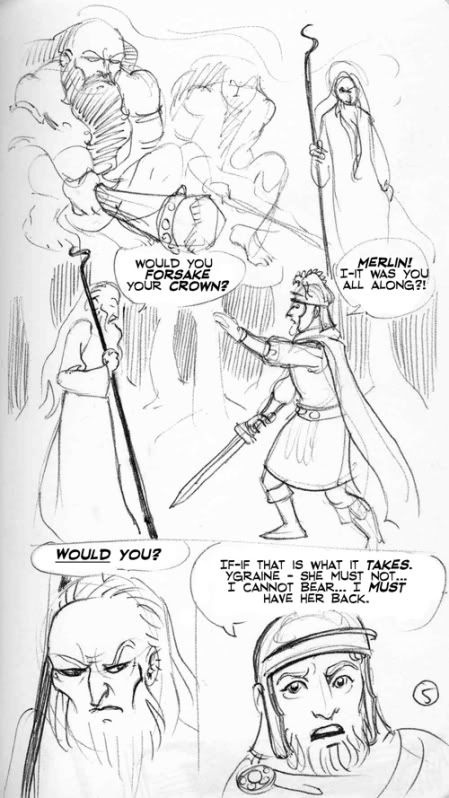
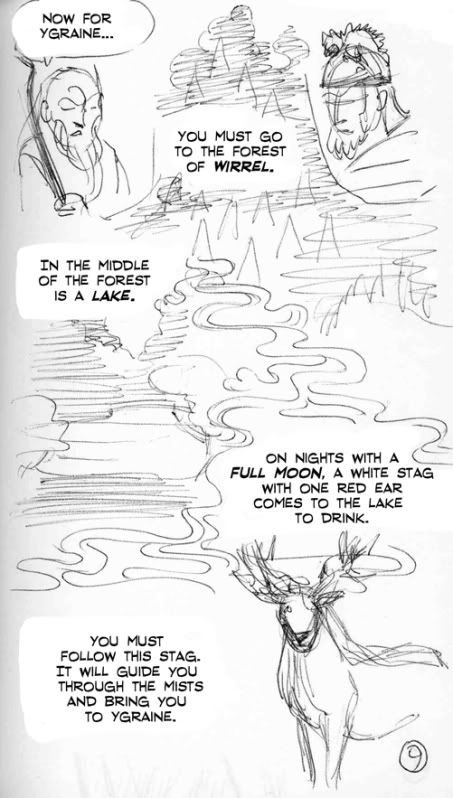
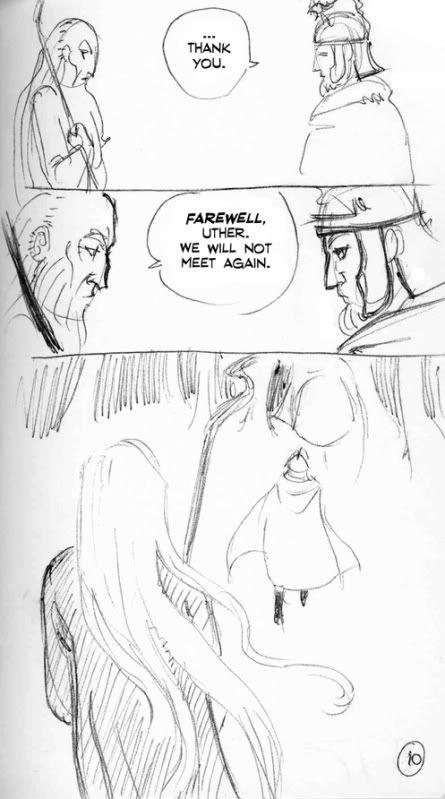
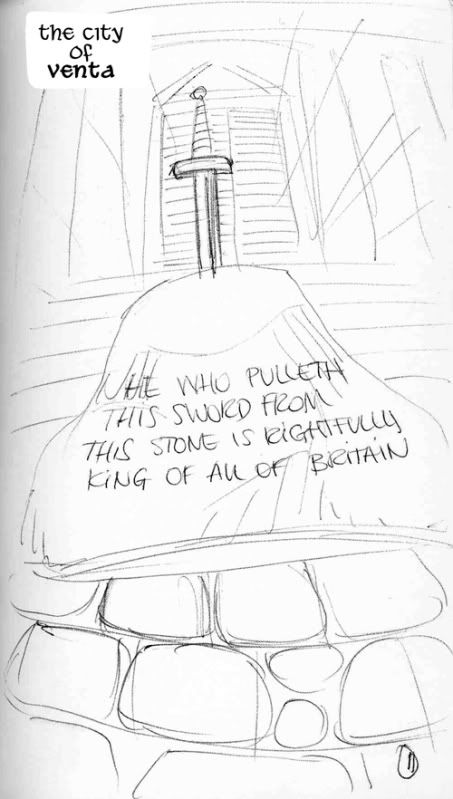
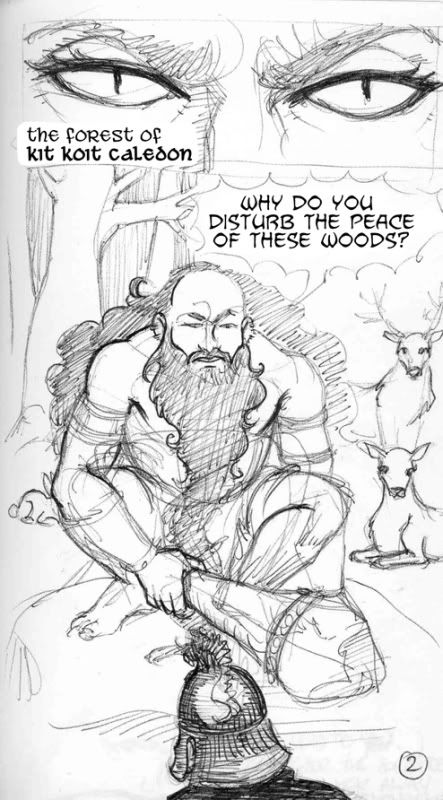
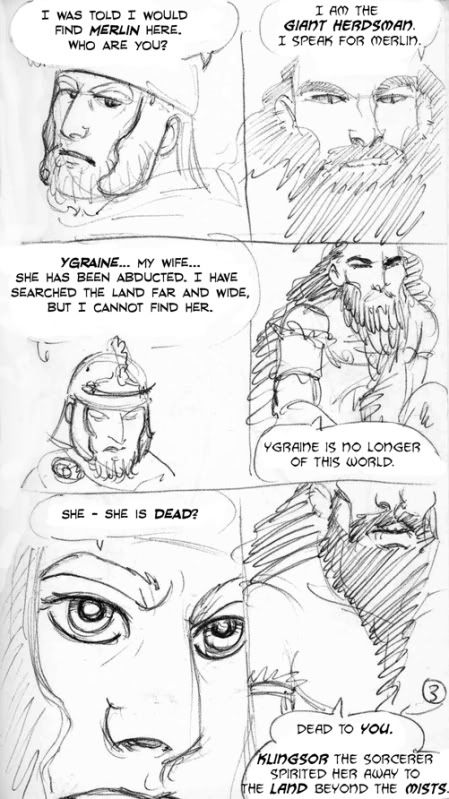
Queen Ygraine has disappeared and Uther is desperate to get her back. He searches the land frantically but can find no trace of his wife. Having heard that Merlin currently resides in the forest of Cit Coit Caledon, he travels there to beg the wizard for help. He is met by the Giant Herdsman instead...


SoK 05

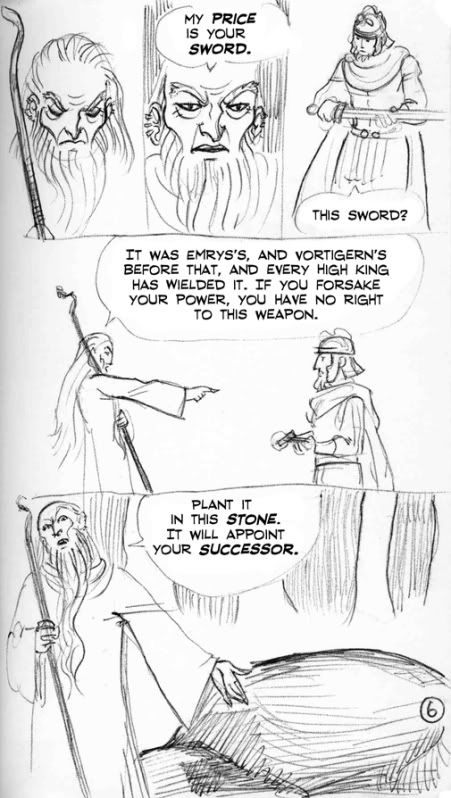
SoK 06

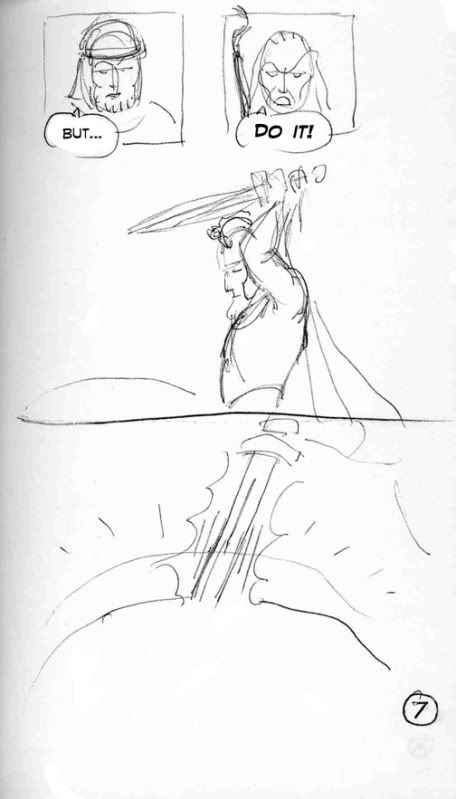
SoK 07

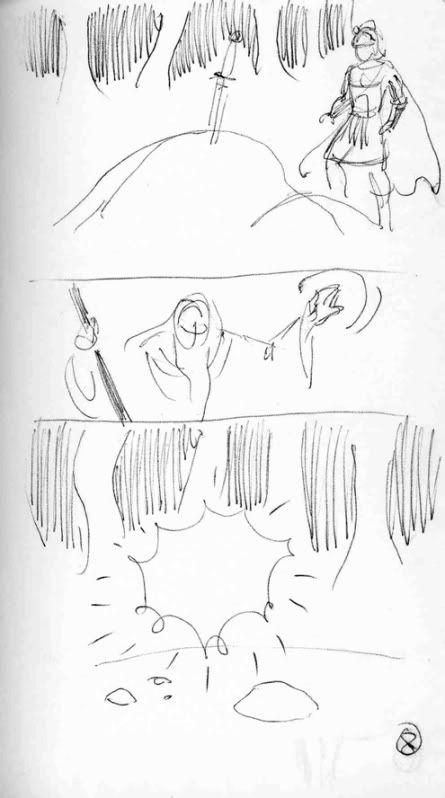
SoK 08

SoK 09

SoK 10

SoK 11


Ah, wonky perspective. It has become my trademark, wouldn't you say? ;P

Hope you enjoyed it a little, even if it was not much more than a bridge episode. Thank you very much for reading!

Saturday, 11 September 2010

Gawain Project: The Sword of Kings 1-4

"Jetzt, wo der gute Utepandragûn seinen Frieden hat... Er ist tapfer herumgeirrt, aber ich glaube kaum, daß er mich finden wollte. Das beruhte zwar auf Gegenseitigkeit, und doch, etwas weniger einig hätten wir uns diesmal schon sein dürfen."

- Adolf Muschg, Der rote Ritter (1993)

Gawain Project banner


The comic is not dead. Whereas some future episodes are already getting a very definite shape, there is still a lot of sorting-out to do on others. One small step has been taken: a short bridge episode is ready. After three rewritings (you won't believe that when you see the result), I am glad that I can finally show you the eleven-page draft of The Sword of Kings. It is short, but not insignificant in the larger scheme of things.

You know the drill: constructive criticism is most welcome. I am very grateful for it and will certainly take it into account for the final version.

A few words about the current draft:
As per usual, I am posting layouts that I have been drawn on the train. They are by no means finished. The SoK drafts have been drawn with a ballpoint pen in a tiny notebook - less than half the size of the notebooks I used for TDH. That wasn't planned. I had been drafting in my usual notebooks, but I got stuck twice on the same plot element that I could not iron out. In the end, I simply didn't take my comic notebooks and pens with me anymore. But whaddayaknow, one day during a train ride I suddenly figured out how to go about it. The only notebook I had on me was tiny, but I could not possibly wait until I got home to write everything down.

The greatest drawback of the small notebook is that my handwriting is necessarily tiny, and therefore mostly illegible. So to make the layouts readable, I had to letter them digitally. The result looks very odd: you get sketchy drawings combined with neat computer lettering. I'm aware of how incongruent that looks, but I didn't have much of a choice :).

Now, on to the comic!


What went before
In The Darkest Hour, you could read how Uther Pendragon, High King of Britain, fell in love with another man's wife. He makes war on Gorlois of Cornwall and, with the help of the sorcerer Merlin, introduces himself into the castle where Lady Ygraine resides with her two daughters, Morgause and Morgana. Gorlois dies in battle and Ygraine cannot escape marrying Uther, whom she loathes. She bears the High King a son, but the child is given to Merlin as payment for his past services. Morgause and Morgana are given in marriage to King Lot and King Uriens, whose support Uther needs in his military efforts against the raiding Saxons. Then, finally, Ygraine finds someone who will help her take revenge: the mysterious sorcerer Klingsor. And so one night Uther wakes up to find his Queen gone...
(Need to re-read? You can do so here.)

This is how the story continues.


SoK 01

SoK02

SoK 03

SoK 04

Saturday, 4 September 2010

The Arthurian Review, Issue 5

A few months ago, I received a package in the mail. It came all the way from the States and contained a 104-year-old book – a 1906 reprint of an Edwardian bestseller. My friend Karina's SO had spotted it at a book mall, “sandwiched between Cajun Cookery and How to Clean Most Everything”, as she tells me, and rescued it. I am very grateful that he did so, because I did not know either the book or its author, and as it turns out, Uther & Igraine holds a few surprises.

Uther & Igraine (1903)

Warwick Deeping

It had been a while since I had last read a baroque Victorian novel, and it seems that I had all but forgotten what it is like. Reading the first few pages of Deeping’s prose was a little like receiving a blow to the head. I was dizzy with the overwrought imagery. Here is a taste:

“A wind cried restlessly amid the trees, gusty at intervals, but tuning its mood to a desolate and constant moan. There was an expression of despair on the face of the west. The woods were full of a vague woe, and of troubled breathing. The trees seemed to sway to one another, to fling strange words with a tossing of hair, and outstretched hands. The furze in the valley – swept and harrowed – undulated like a green lagoon.”

Mr Deeping (1877-1950), it is clear, likes his Aesthetes. He harnesses the worst affectations and most artificial phrasing of Wilde and Swinburne to write a romance novel. He adds positively lethal doses of alliteration and superfluous adjectives to the mix. In fact, his writing reminds me painfully of my own prose style :P. To do myself justice, I don’t insist on using “panier” when I could write “basket”, or “potage” instead of “soup”. Deeping does. As soon as I got used to it, I actually found his pedantry funny and went along with it.

Uther & Igraine is pure historical romance. When I say “historical”, I mean it in the widest possible sense. The story is set in what looks like post-Roman Britain, but the author adds all sorts of elements that evoke chivalry and courtly love and do not match the timeframe at all. Everything in this novel serves the romance. Characterisation, historicity and background: they are all (mostly cardboard) props to decorate the stage on which the Passionate and True Love of Uther and Igraine is shown. But if you can accept the novel for what it is, it is quite an enjoyable read, and much less silly than many of its modern counterparts.

“The true love of Uther and Igraine”? You heard it right. In Mists of Avalon, Uther is young and a hottie, and Igraine falls in love with him because her husband Gorlois is old and considerably less hot. Deeping’s scenario is somewhat different. In 1903, an adulterous love affair could not possibly have a happy ending, and happy endings are what romance novels are all about. The solution to this problem is to turn the source legend on its head. In Uther & Igraine, it is Gorlois who calls upon Merlin to trick Igraine into marrying him when he finds that she is not responsive to his advances. (This despite the fact that he has such romantic notions of wooing, including stalking his beloved, manhandling her, and showing her a lot of crucified Saxons.) If Igraine rebuffs Gorlois, it is not only because he is vain, cruel and insensitive, but also because, just before, she has fallen in love with the mysterious Pelleas. That intensely honourable, valiant and (quite maddeningly) devout knight turns out to be none other than Prince Uther. Igraine and Pelleas part, due to an unfortunate misunderstanding, and do not meet again until after Gorlois has perpetrated his dastardly deed. In the service of the happy ending, the Duke of Cornwall eventually pays for his awful treatment of the heroine by kicking the bucket (forcefully) and leaving Uther free to marry his widow with a clear conscience.

My little summary might lead you to assume that Igraine spends the entire novel playing the part of damsel in distress. If it is true that she has to suffer violence, trickery and death threats, it should nevertheless be mentioned that she is also a brave girl with a sharp tongue who is not content to let other people decide her fate. She fires arrows at Saxons, lies and tricks, jousts if she has to – no, she is no wilting lily. Of course she becomes “as a child” when Pelleas is near, and she goes insane at one point, as Victorian conventions demand, but in general she is rather more emancipated than her sisters in the pseudo-feminist Arthurian novels of the 1990s. Take that, Rosalind Miles!

Should you feel like reading this cute, quirky little romance, I am happy to report that it is widely available in digital form on the Internet.

On the Gawain-o-meter:

Zero! There is no trace of Gawain, which is not surprising seeing as Igraine is very young and has no children yet. If there is neither a Morgause nor an Anna, there is not going to be a Gawain either. I have no idea how Deeping envisions Arthur’s family tree.

To prove how much fun I had reading this book, I doodled three characters while on the train. Please note that Morgan is not Morgan le Fay – she is Morgan la Blanche, who does not seem to have a counterpart in the source legend (or not that I can see).

Photobucket

Friday, 27 August 2010

The Arthurian Review, Issue 4

(CONTAINS SPOILERS for both seasons)

Merlin Season One

Merlin Season Two


I discovered the BBC series Merlin when it was already halfway Season Two. The first episode I saw, The Sins of the Father, immediately made me curious for more. I ordered the first box set and liked that well enough to get the second one, too. Now, while all Merlin fans are anxiously awaiting Season Three, I’d like to share a few thoughts. Those thoughts are a mixed bag, really. That is because on the one hand, I find Merlin very enjoyable, but on the other, I find it rather disappointing. I guess the mixture of shortcomings and enjoyment qualify it as something of a guilty pleasure.

Merlin features many familiar characters from Arthurian legend, but places them in a kind of alternate universe. Merlin is the same age as Arthur, and Arthur is being raised by his father, King Uther, instead of by a foster-father appointed by Merlin. (One unfortunate consequence of this is that the series must do without the delightfully sarcastic character of Sir Kay – no foster-father for Arthur means no foster-brother either.) True to the original legend, Morgana is Uther’s ward; but in the series she, too, is about the same age as Arthur. In an interesting twist, Guinevere is Morgana’s servant, and after all the well-known images of a blonde Guinevere, it comes as a surprise that the BBC series’ Once and Future Queen has African roots.

Merlin’s Camelot is a land ruled by a king who fanatically opposes magic. Uther prosecutes witches, wizards and magical creatures ruthlessly. This poses a bit of a problem for Merlin, a prodigious magical talent who must conceal his powers if he wants to keep his head. To complicate matters, Merlin is made a servant to Prince Arthur, in which capacity he is constantly under Uther’s nose. Discretion is advised. So naturally, in every episode some magical threat manifests itself that can only be stopped by means of Merlin’s own magic.

The ties between Merlin and the legends to which the main characters’ names refer are really rather thin. If you feel inclined to be critical, you might well ask why the writers choose to call their characters Merlin, Arthur, Guinevere, Lancelot and Morgana if they are going to be barely recognisable as the figures of legend. The makers are not filming their own version of Arthurian legend; they are making a fantasy series with Arthurian touches. The best comparison I can think of is with J. K. Rowling’s use of myth and legend in Harry Potter. It’s not deep, it’s not particularly meaningful, but it adds some couleur locale and it’s fun if you get it. This is something you have to accept in order to enjoy the show.

Merlin is an enjoyable show but doesn’t withstand scrutiny. Maybe what I miss most is a clear creative vision. Shows like Buffy the Vampire Slayer and Kaamelott are driven by a creator who knows very well where the characters are going and who write episodes that serve the development of those characters. There are themes and larger arcs that give structure to each season. For Buffy, Joss Whedon worked with a small army of writers, but each script would be submitted to him to ensure that it was consistent with his vision and coherent within the whole. A season of Merlin, on the other hand, seems to consist merely of 13 loose episodes. This is even more the case for Season Two than it was for Season One. Whereas interesting issues and plot points may be brought up within an episode, more often than not these elements will be buried by the end of the episode, let alone that there would be a sign of continuity in the next. One blatant example is of Morgana vociferously disowning Uther in Episode 11. Despite the fact that Uther does not take very will to this kind of behaviour, Episode 12 still finds Morgana living quietly in Uther’s castle and telling Morgause that she “has to pretend to be Uther’s loving ward”. I don’t see a lot of pretending anymore, but that might just be me.

Likewise, there seems to be a sad lack of ideas among the script writers. Twice now, Arthur has been bewitched to fall in love with someone (Uther, just the once, but it lasted two episodes). Twice now, we have been served the same big revelation about Arthur’s birth. And countless times, Arthur is accidentally knocked out so as to allow Merlin to do some hocus-pocus unnoticed. At the same time, the scripts do provide lots of elements that could be taken further. There is Gaius’s past as a magician. There is the fact that sooner or later, Arthur must find out that Merlin is a wizard. Uther must realise that Morgana has magical powers. And what’s with the family connection of Morgana and Morgause (and/or Arthur, if applicable)? All these things are touched upon, but they never seem to go anywhere. It seems as if the writers try to draw everything out as much as possible – if, at least, you can trust them to have sown these seeds deliberately.

The writers have taken the Arthurian characters out of the framework of the legend, but they seem to have forgotten to build a framework of their own – or if they do have a framework, they are not making good use of it. I suppose people will say it’s a children’s show (actually it’s supposed to be ‘all audiences’) and that therefore it must not be too complex, but I find that more often than not, that argument is used as an excuse for laziness. I have read picture books for five-year-olds that have more subtlety and layers than a Merlin episode or, for that matter, a Harry Potter book. It is perfectly possible to create something that can be appreciated by children and yet does not make older readers/viewers feel as if they are too old or too smart to be reading/watching it.

So, why do I actually watch Merlin, and enjoy watching it, if my criticism is so harsh? Well: I guess that a very good reason for watching is the cast and the obvious pleasure they take in participating in the show. Colin Morgan’s Merlin is a sweet, clumsy and very winning young wizard whose chemistry with Bradley James (Arthur) is undeniable. Both Morgan and James are adorable comedians, but they don’t disappoint in dramatic moments either. And it’s great fun to watch these two interact. Angel Coulby makes a very loveable Guinevere, a devoted servant who nevertheless shows the kind of strength to convince you that she would make a great queen. The weakest link in the young cast, in my opinion, is Katie McGrath, who is gorgeous as Morgana but inclined to overact a little at times. The young actors are complemented by ‘old hands’ Anthony Head – formerly known as Rupert Giles, here a delightful King Uther – and Richard Wilson as Gaius, court physician and Merlin’s grandfatherly mentor. Moreover, Merlin has an excellent cast of villains, including Charles Dance, Mackenzie Crook, Adrian Lester and Emilia Fox.

Season Three is being filmed at this moment, and from what I have heard, it will have larger story arcs than Season Two. Let us hope that some of the other issues will be solved too. The actors – and the audience – deserve a little more effort.

And on the Gawain-o-meter...

Merlin simply doesn’t register – yet. Let’s check back after Season Three, which certainly shows promise :).

Friday, 20 August 2010

TDH pages 6 & 7

Today: a preview of my first two pages of the definitive TDH. No speech bubbles or texturing yet - these things are to be added digitally. Page 6 is inked with Staedtler pens and a Pentel brush pen on A3 Bristol board. I had only just finished it when I started noticing its flaws, but that's how it always goes :/.

Below: pencils for page 7. As you can see, it is decidely less crowded than page 6. I was exceedingly happy with it when it was just done, but in the meantime I think that it probably looks a bit haphazard. Argh.


Constructive criticism = welcome.

Friday, 23 July 2010

Digital painting

Oh look, it's an update! ;-)

I have been pottering around with Photoshop and came away from a tutorial with a really helpful tip: locking transparent pixels! That means that once you have set down a flat colour for a particular area, you lock the transparent pixels for that layer, and when you set down the shadows, you stay neatly within the right colour area. It makes painting in Photoshop that much easier. So I couldn't resist trying out my newly-honed skill on some old line art.


This girly cutie is Ambiorix from my (long-term) War in Gaul project.


And this big brute is Conan the Barbarian, drawn last year as a birthday gift for the only Conan fanboy of my acquaintance ;).

The contrast between those two almost hurts my eyes. Heh.